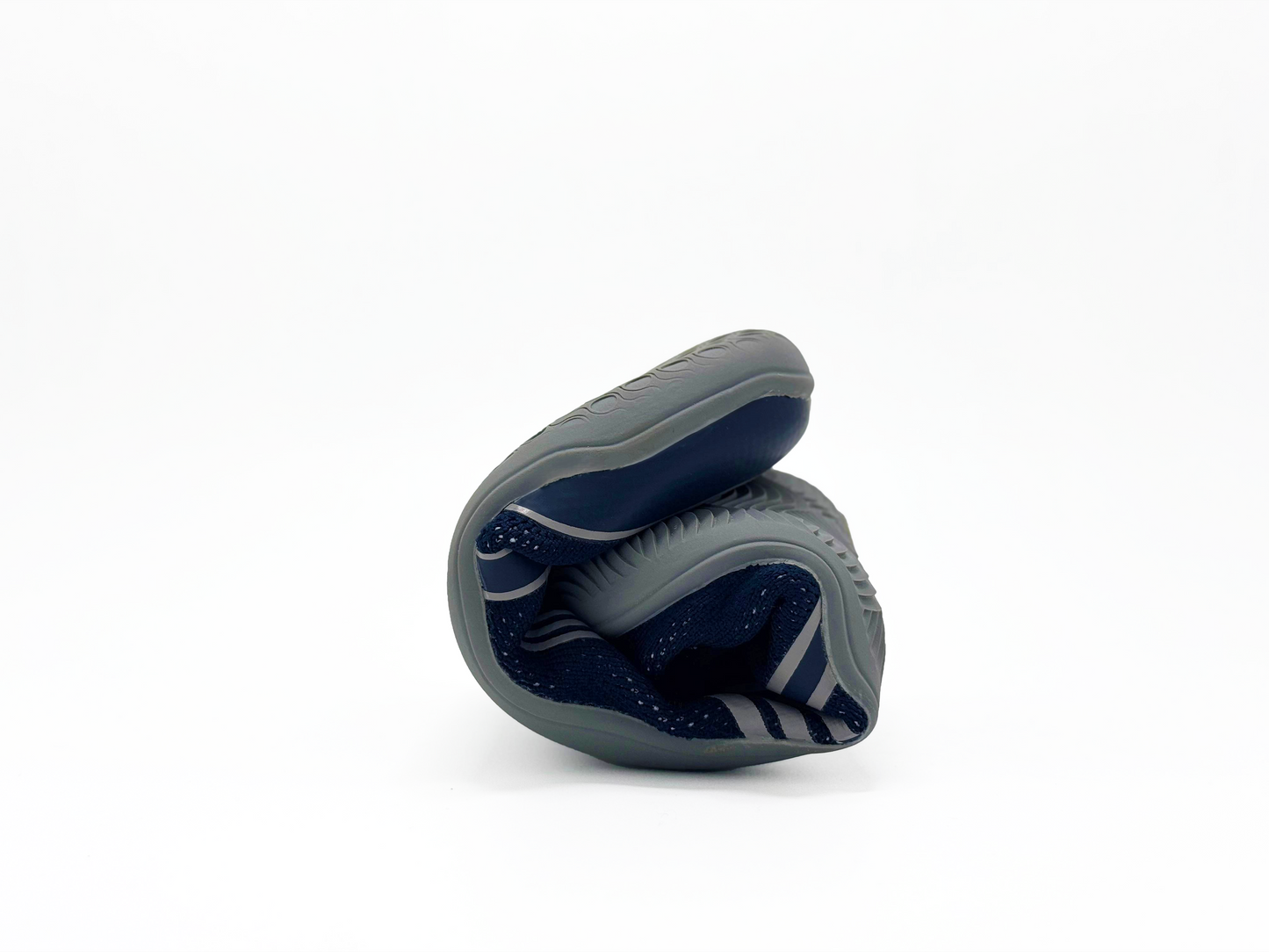
Zero Drop Shoes Explained: What They Are and Why Indian Runners Are Switching
If you've been shopping for running shoes recently, you've probably come across the term "zero drop", maybe in a product description, a running forum, or a YouTube video. It sounds technical. Maybe even a little intimidating.
It isn't. It's actually one of the simplest and most important things to understand about footwear, and once you get it, you'll never look at a pair of shoes the same way again.
This post explains what zero drop means, what it does to the way you walk and run, and why more and more Indian runners are actively seeking it out.
Start here: what is heel-to-toe drop?
Every shoe has what's called a "heel-to-toe drop" , sometimes just called "drop" or "offset". It's simply the height difference between the heel and the forefoot of the shoe.
If the heel of a shoe is 20mm thick and the forefoot is 8mm thick, the drop is 12mm. That's the number you'll sometimes see in shoe spec sheets written as "12mm drop" or "12mm offset".
A zero drop shoe has no height difference at all. The heel and the forefoot are exactly level, the same distance from the ground. Your foot sits flat, the way it does when you stand in your bare feet.
Quick visual: Stand barefoot right now. Look at your foot from the side. Your heel and the ball of your foot are at the same height from the floor. That's zero drop. Now put on a regular running shoe. Your heel is suddenly elevated 10–12mm higher than your toes. That's what most shoes do to you, all day, every day.
What most running shoes actually look like
Standard running shoes, from the big mainstream brands, typically have a heel-to-toe drop of 8mm to 12mm. Some older or more "supportive" models go even higher, up to 14mm.
This became the default design in the 1970s and 80s when shoe companies started adding thick cushioning to heels, primarily for marketing reasons, the idea that more cushion meant more comfort and less injury. The drop was a side effect of that design, not an intentional biomechanical choice.
Over the following decades, we simply got used to elevated heels in our shoes. And our feet and movement patterns adapted, in ways that aren't always great for us.
What an elevated heel actually does to your body
This is where it gets interesting, and where a lot of runners have an "I never thought about it that way" moment.
It changes how your foot strikes the ground
When your heel is elevated, the most natural thing to do when running is to land on that heel first, what's called heel striking. Your body follows the path of least resistance. But landing heel-first while running sends a significant impact force straight up through your heel, ankle, knee, and lower back with every single step.
Running biomechanist and Harvard professor Daniel Lieberman spent years studying this. He found that barefoot runners, and runners in zero drop shoes, naturally shift to a midfoot or forefoot strike, landing with a bent knee under the centre of their body. This absorbs impact far more efficiently. The research was published in Nature and changed how sports scientists think about running mechanics. You can find it on our barefoot research page.
It tightens your calf and shortens your Achilles
When your heel is permanently elevated in shoes, your calf muscles and Achilles tendon spend most of their time in a slightly shortened position. Over months and years, this can lead to tightness, reduced flexibility, and a higher risk of Achilles injuries when you do activities that require a fuller range of motion, like squatting, trail running, or playing a sport that involves sudden direction changes.
It affects your whole posture
Your body is a chain. Elevating the heel tips the pelvis slightly forward, which affects the lower back curve, which affects shoulder position, which affects your neck. Most people don't connect their lower back discomfort to their footwear, but it's a more common link than you'd expect.
So what does zero drop actually do?
When you remove the heel elevation, a few things happen:
• Your foot lands more naturally. Without the heel pushing you forward, your foot naturally finds a midfoot or forefoot strike when running. Load is distributed across more of your foot, and the impact is absorbed by your muscles and tendons , which is what they're designed for , rather than jarring your joints.
• Your calf and Achilles get their full range back. Over time, with gradual transition, your posterior chain regains flexibility. Many runners report that chronic calf tightness eases considerably after switching to zero drop footwear.
• Your posture realigns. Standing with your heel at the same height as your forefoot allows your spine to stack more naturally. It's subtle at first, but noticeable over weeks.
• Your foot muscles wake up. In a zero drop shoe, especially one with a thin flexible sole, your foot has to do actual work to support itself. The intrinsic muscles of the foot , which largely sit dormant in cushioned, supportive shoes , start firing again. Over time, this builds genuine foot strength.
How to tell if a shoe is zero drop , right now
You don't need a spec sheet. Here are three ways to check any shoe:
The table test
Place the shoe on a flat table and look at it from the side. If the heel sits noticeably higher off the table than the toe area, it has a significant drop. If both ends sit at the same height (or very close to it), the drop is low or zero.
The finger test
Put your fingers under the heel of the shoe, then under the forefoot. Count how many fingers fit. If you can fit two or three fingers under the heel but only one (or none) under the forefoot, that's your drop right there.
Check the spec sheet
Most brands now list heel-to-toe drop in millimetres in the product specifications. Look for "drop", "offset", or "heel-to-toe differential". Zero drop shoes will say 0mm. Anything under 4mm is considered low drop. 8mm and above is standard to high drop.
On Zen Barefoot shoes: Both the Origin trainer and the Kairos sneaker are zero drop. The heel and forefoot are exactly level, placing your foot in the same position it would be in barefoot. You can verify this with the table test the moment yours arrive.
Why Indian runners specifically are making the switch
There's something worth saying about the Indian context here.
India has a long cultural tradition of minimal footwear, chappals, kolhapuris, padukas, and of going barefoot in many daily contexts. For much of our history, Indian feet were strong, mobile, and well-adapted to natural movement. Studies of populations in India who had never worn structured shoes found very low rates of foot deformity and a significantly broader, more mobile foot. You can read more about that research on our barefoot research page.
The shift to Western structured footwear, particularly in schools and offices over the past two to three decades, has changed this. Indian runners, many of whom grew up wearing minimal footwear, are now experiencing the same overuse injuries that Western runners have been dealing with for years: runner's knee, plantar fasciitis, IT band syndrome, shin splints.
A growing number of Indian runners are connecting the dots. They're reading the biomechanics research, noticing that elite barefoot and minimal-shoe runners from East Africa have some of the lowest injury rates in the world, and asking whether their shoes, not their bodies, might be the problem.
Zero drop shoes don't ask you to run differently by willpower. They make the natural way of running the path of least resistance again.
The honest part: transition takes time
Zero drop shoes are not a switch you flip overnight. If you've spent years in 10mm+ drop shoes, your calf muscles, Achilles, and movement patterns have adapted to that elevation. Going straight into zero drop for a full run is a reliable way to get sore.
The transition needs to be gradual, start by wearing zero drop shoes for daily walking before running in them, build up slowly over weeks, and give your body time to adapt. We've written a detailed guide on exactly how to transition to barefoot shoes if you want a week-by-week approach.
Most runners who transition properly find that within two to three months, running in zero drop shoes feels not just normal, but better, lighter, more connected to the ground, and with noticeably less fatigue in the hips and knees.
Zero drop vs barefoot shoes vs minimalist shoes, what's the difference?
These terms are often used interchangeably but they're not identical:
• Zero drop refers specifically to the heel-to-toe drop measurement. A shoe can be zero drop and still have significant cushioning.
• Minimalist shoes generally means shoes with less material overall, thinner soles, less cushioning, less structure, but there's no standardised definition.
• Barefoot shoes is the most complete category: zero drop, wide toe box, thin and flexible sole, no artificial arch support. The goal is to let the foot function as close to barefoot as possible while still having protection.
Zen Barefoot shoes are all three, zero drop, minimalist in construction, and designed around barefoot principles. The zero drop is necessary but not sufficient on its own; the wide toe box and thin sole matter just as much for healthy foot function.
Frequently asked questions
Is zero drop good for beginners?
Yes, but transition carefully. Zero drop shoes are actually closer to how the human foot is designed to work, it's elevated-heel shoes that are the modern invention. That said, if you're coming from years of high-drop running shoes, your body needs time to adapt. Start with walking, build up gradually, and don't rush mileage in the first few months.
Can zero drop shoes help with knee pain?
For many runners, yes, particularly if the knee pain is connected to a heavy heel-strike running pattern. Shifting to a midfoot/forefoot strike, which zero drop shoes naturally encourage, reduces the impact forces transmitted to the knee. If you have a pre-existing injury, check with a physio before making any significant change to your footwear.
What drop is best for running?
Research increasingly supports lower drop for recreational and long-distance runners who want to reduce chronic injury risk. Many elite long-distance runners , particularly those from East Africa who train barefoot or in minimal footwear , have some of the best injury records in the sport. That said, if you're currently pain-free in higher-drop shoes, don't fix what isn't broken. The key is gradual movement toward less elevation over time.
Are zero drop shoes the same as flat shoes?
Not exactly. "Flat" usually just means there's no visible heel lift from the outside. A zero drop shoe is specifically designed so the heel and forefoot are at the same height relative to the ground inside the shoe. Some seemingly flat casual shoes still have internal heel elevation you can't see. Use the finger test above to check.
Which Zen Barefoot shoe should I start with?
If you're primarily a runner or gym-goer, the Origin trainer is built for training and movement. If you want something for everyday wear that you can also run in, the Kairos sneaker works for both. Both are zero drop, wide toe box, and made for barefoot-style movement. Before you start running in either, read our transition guide , it'll make the process significantly smoother.